Urge for Sustainable Infrastructure
Urge for infrastructure projects that are planned, designed, constructed, operated, and decommissioned in a manner to ensure economic and financial, social, environmental (including climate resilience), and institutional sustainability over the entire life cycle of the project.

The United Nations agreed on a resolution on “sustainable infrastructure” at the fourth session UN Environment Assembly (UNEA-4), held 11-15 March 2019, in Nairobi, Kenya.
What is sustainable infrastructure?
The Inter-American Development Bank Group working definition of sustainable infrastructure as “infrastructure projects that are planned, designed, constructed, operated, and decommissioned in a manner to ensure economic and financial, social, environmental (including climate resilience), and institutional sustainability over the entire life cycle of the project.”
The UNEA resolution calls on Member States and all other relevant stakeholders to:
Embrace system-level approaches to the development of infrastructure,
Apply sustainability criteria in the infrastructure development process,
Enable a national environment for the promotion of sustainable infrastructure,
Build, or continue to build, technical and scientific expertise in developing countries,
Further nature-based solutions, and
Promote new or strengthen existing public-private partnerships (PPPs) and mutual exchange.
New OECD estimates suggest unprecedented levels of investment, around USD 95 trillion, are needed from 2016 to 2030 in infrastructure (energy, transport, water and telecoms), even before considering climate and pollution challenges.
The bulk of this investment will involve developing countries, including fragile states, low-income economies, and emerging economies to sustain growth and meet the basic needs generated by rapid population growth and urbanization. Developed countries will also require investments to retrofit ageing infrastructure and for mitigation and adaptation to climate change.
Venezuela alone will need as much as $80 billion over several years, in loans and investment, to restore basic functions, and embark in the process of rescue, recovery, and social, economic, and political transformation of the country once the shift to political democracy is achieved.
Mexico Oil & Gas auctions for 2018: Offshore and Onshore
The Oil & Gas auctions for 2018 will include deep-water, shallow-water, and onshore blocks (shale plays).
Due within the first year after the Effective Date: Environmental Baseline Assessment (LBA), Environmental Impact Assessment (MIA), Social Impact Assessment (EVIS), HSE Management System (SASISOPA), Water Resource Permits, Waste Management Permits, HSE Notifications, ... Exploration Drilling Authorization
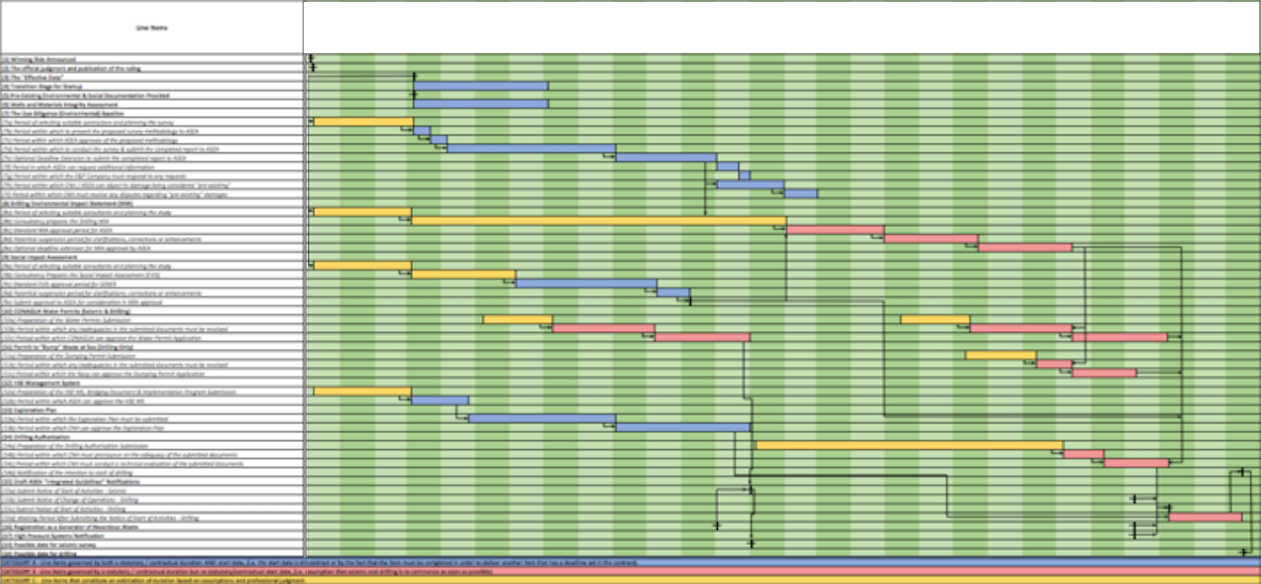
HSES Timeline
HSE International has performed dozens of offshore and onshore assignments in Mexico providing HSES support services to the O&G industry. Some examples include:
- Risk assessment and regulatory advice
- Permitting planning and compliance
- HSE Management System
- Sustainability-seeking E&S MS with IFC PS and WBG EHS Guidelines
- Locality strategy for entry in new area / new projects
- HSES Due diligence
- Social and environmental baseline and impact assessment
- In-country support to offshore and on-shore oil and gas activities
- Training and capacity building
HSE International's consultants deliver strategy, clear advice and support with implementation in a way that is culturally and locally savvy.
For more information contact us at: solutions@hseinternational.com, (+1) 281.971.5909 www.hseinternational.com
Mexico: four more Oil & Gas auctions for 2018

HSE International, LLC
Mexico could launch up to four more oil and gas auctions before the end of 2018. The tender could include shallow-water fields as well as gas-rich shale areas. The government had previously mentioned three more tenders were planned, but a fourth could be a mix of fields including some deep-water areas.
Round 2.3 - Depp Water
This bid round includes 30 deep-water blocks for exploration in the Perdido Area, Salinas Basin, Mexican Mountain Chains (Cordilleras Mexicanas) and the Yucatan Platform, collectively an area three times the area for deep-water Round 1.4. Most of the blocks have an area of 2,000 square kilometers. The blocks in this Round will be awarded based on a license contract and include wet gas and dry gas, which will help reduce imports. The presentation and opening of proposals is scheduled for January 31, 2018.
Round 3.1 - Shallow Water
35 shallow water contractual areas under Production Shared Contracts integrate round 3.1. These contractual areas are divided into three sectors: Burgos, Tampico-Misantla-Veracruz and Cuencas del Suereste basins. These blocks have a range of prospective resources ranging from light to heavy crudes, as well wet and dry gas blocks. The auction is scheduled for March 27, 2018.
HSE International has performed dozens of offshore and onshore assignments in Mexico providing H&S, Environmental and Social (HSES) support services to the Oil and Gas industry. Some examples include:
- Risk assessment and regulatory advice
- Permitting planning and compliance (ASEA, SENER, CNH, other agencies)
- Social and environmental baseline and impact assessment
- Strategic social and environmental performance project
- Sustainability-seeking management systems with IFC PS and WBG EHS Guidelines
- Locality strategy design and implementation for sustainable development
- Due diligence
- In-country support to offshore and on-shore oil and gas activities
- Training
HSE International supports clients with a contextualized, integrated and cost-effective approach, delivering innovative solutions and helping clients manage their risks in a way that is culturally and locally savvy. Learn more about the services we offer and our extensive international experience spanning 35 countries, including Mexico.
solutions@hseinternational.com (+1) 281.971.5909 www.hseinternational.com
Mexico Oil & Gas "Apertura" - Round 2 – 1st Call for Bids: 15 Shallow Water Blocks
Mexico Oil & Gas "Apertura" - Round 2 – 1st Call for Bids: 15 Shallow Water Blocks

Mexico launched on July 20th the first call for Round 2 of its Oil & Gas "Apertura", which covers 15 shallow water offshore blocks.
The blocks are located along the coasts of Tampico, Misantla, Veracruz and southeastern Gulf of Mexico area. The bidding process will take 8 months with awards of the offshore blocks are scheduled for March 2017.
Shallow Waters and Above-Ground Risks
Successful bidders (e.g. IOCs) for the blocks located in shallow water of the Gulf of Mexico will sign a production sharing contract for 30 years with two possible extensions of five years.
These shallow water blocks present above-ground non-technical risks, that if inadequately managed often translate into project delays and cost overruns, and operational interruptions during the project life cycle.
The area encompassed by the Round 2 shallow water blocks is geographically extensive and environmentally diverse, and it includes sensitive areas with high biodiversity as well as communities that rely on natural resources.
Initial engagement with stakeholders has identified environmental and social concerns, and communities’ needs among those living closest to the oil and gas areas, including for example:
· Impacts to ecosystems due to spills and leaks and wastewater discharges,
· Increase in vehicular and vessel traffic,
· Impact on existing local infrastructure and services,
· Community health and safety,
· Local content requirements,
· Income generating opportunities,
· Skills training,
· Education, and
· Basic services.
These challenges and expectations require a contextualized and integrated approach, and innovative solutions to manage the sustainability non-technical risks to ensure the success of the Apertura and oil and gas business ventures in Mexico.
How HSE International, LLC can help
The successful IOCs need to develop and adopt, from the onset, strategies based on a framework that integrates social, economic, environmental, and institutional factors, to have a clear vision for how to operate in the area.
HSE International’s experience working in the oil and gas industry, in environmentally sensitive and complex social settings, and our international delivery capabilities working with local strategic partners in Mexico, can help IOCs develop and implement strategies based on a sustainability framework.
HSE International’s Sustainable Development Analysis (SDA) combines social, economic, environmental, political and institutional analysis to improve the understanding of the linkages between development dynamics and the political and social structures that shape development outcomes.
We have the knowledge and experience to assist IOCs develop and implement sustainable development frameworks to address these issues early in the project cycle, helping Companies’ manage the above-ground risks and impacts, and contribute to earning and maintaining the regulatory and social licenses to operate.
HSE International has worked in the Mexico’s oil and gas sector since 2008, including supporting IOCs, NOCs and Regulators, along the oil and gas value chain. We have developed a process to address social, environmental, security and safety risks each step of the way, and are eager to contribute to a more sustainable development of the oil and gas sector in Mexico.
For more information on how to manage above-ground non-technical risks, read HSE International’s post http://www.hseinternational.com/news-insights/2015/5/mexicos-oil-gas-apertura-shallow-waters-and-above-ground-risks, and email us at: solutions@hseinternational.com
What's next for Mexico’s Oil and Gas E&P “Apertura”

The next bidding round in the opening of Mexico's oil and gas sector, named 2.1, will be called by the end of July and consist of 15 shallow-water blocks for exploration and extraction work in the Gulf of Mexico.
The following round, or 2.2, would be called by the end of the summer and consist of of 14 onshore blocks for E&P work in the gas-rich Burgos Basin in the north of the country, as well as in southeast Mexico, according to government officials.
Rounds 2.1 and 2.2 may result in a higher proportion of contracts being awarded. However, companies will remain cautious, seeking to secure more attractive conditions for unconventional contracts, due to low oil prices ($44 per barrel as of July 19th), and social and security risks of operating in Mexico.
The situation is not unlike many other experiences in newly opened regions of Latin America and other continents, in which community relations and security risks continue to emerge as critical issues for the energy sector.
Experience says that those projects that have suffered delays and cost overruns during the initial phases are likely to be overwhelmed with problems during subsequent project phases.
Successful bidders (specially the international oil companies - IOC, to be operating in Mexico’s oil and gas sector) will face challenges that have the potential to escalate very rapidly.
This is mainly due to the lack of appropriate and timely engagement and information that is available to communities and local stakeholders who may also feel their grievances in the past have not been adequately considered.
To avoid these situations, there is a need for the Government to conduct strategic assessments and engagement, and promote the implementation of good international industry practices.
The IOCs need to develop and adopt “entry strategies” and early engagement with communities and other stakeholders. The strategy should be based on a sustainable development framework that integrates the result of social, environmental, political, and institutional analysis, to improve the understanding of the linkages between development dynamics and social structures that shape development outcome.
These challenges and stakeholder expectations require a contextualized and integrated approach, and innovative solutions to manage the sustainability non-technical risks to ensure the success of the oil and gas business ventures in Mexico.
How HSE International, LLC can help
HSE International uses its sector-focused approach, deep knowledge and experience of the oil and gas industry operating in complex social settings, and international delivery capabilities, including local strategic partners to help our clients.
HSE International has worked in the Mexico’s oil and gas sector since 2008, including supporting IOCs, NOCs and Regulators, along the oil and gas value chain. We have developed a process to address social, environmental, security and safety risks each step of the way, and are eager to contribute to a more sustainable development of the oil and gas sector in Mexico.
For more information email us at: solutions@hseinternational.com